

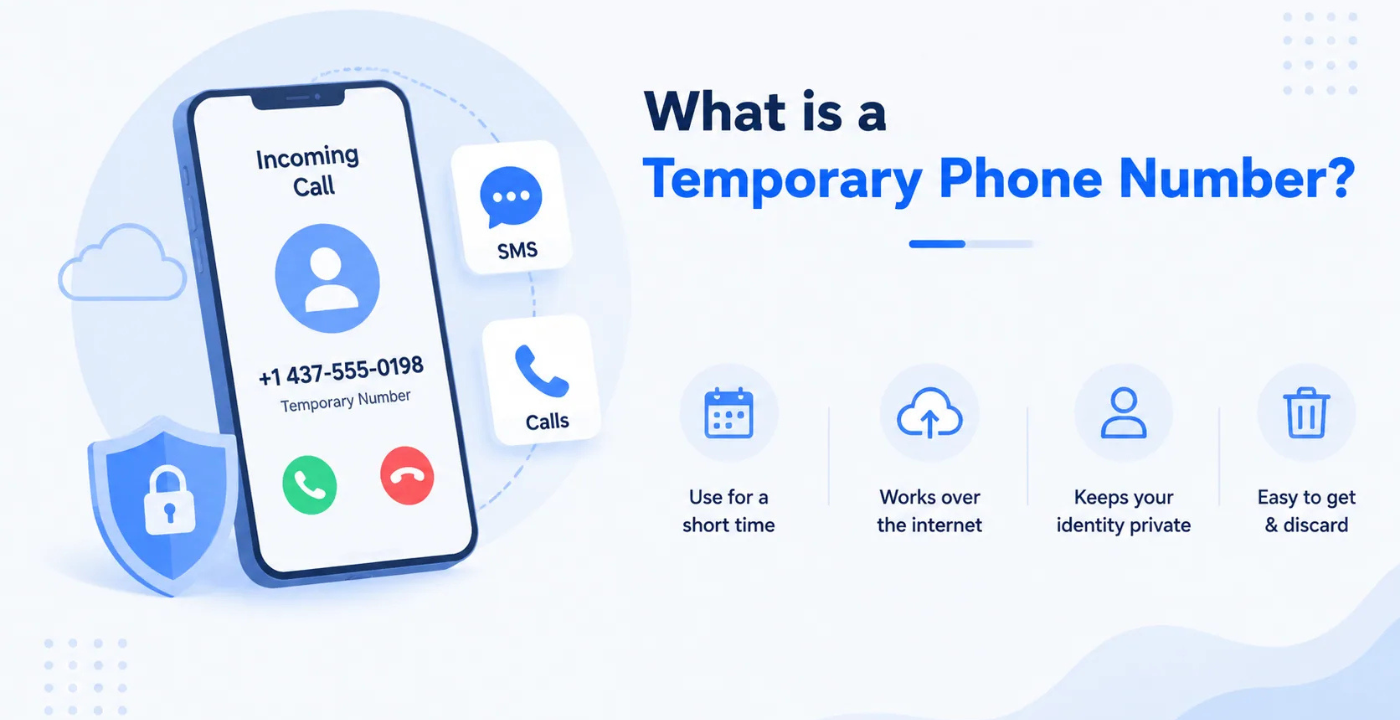
But if you’ve ever been hesitant to enter your actual cell phone number into an unknown site or application, you are not the only one. Instead, many users are opting for a temporary phone number these days, which is a temporary number that can be used for a temporary period of time to verify, sign up or make a one-off call without revealing any personal contact information.
This article will go over what a temp number is, why people use one, and what things you should consider when picking a service, in a language that anybody can read and understand.
What Is a Temp Number?
A temp number is a phone number that’s assigned for a temporary period for non-permanent use. It has no need to be bound to a physical SIM card or a mobile contract, but it’s typically provided via an app or website that then displays a number that works for a short time. In that time, the number can receive calls and texts just as a regular one, but after the task is completed, the number can be deleted without any consequences.
The one thing that is different about this number with the regular one is the permanence. A normal number remains with you for years and is associated with your identity, billing address and personal accounts. A temp number, however, is not meant to be kept for the long haul and that is where it can be beneficial; when privacy or short term access is more important than long term ownership.
Why People Use a Temp Number

There are a number of common situations people might find themselves in where they’d rather use a temporary number than their own. This is most frequently about privacy. If you are not sure if the service you’re trying to join is reliable or if you don’t need to know the numbers you’re giving, you can use a disposable provider to keep your primary phone number confidential. It’s also commonly used to verify an account, as numerous websites and applications require confirmation via text message code prior to gaining access.
Another reason for avoiding spam is motivation. After making a number public or it’s used on many platforms, it’s likely to begin receiving unwanted calls and messages. A temporary substitute takes up that risk, not your personal effort. Last but not least, the following sorts of scenarios are common when a throwaway number is more efficient than a permanent one: selling something online, dating an individual using a dating service with caution, trying out a complimentary trial with a company that asks for a phone number, etc.
Read Also: How Many Ounces Is a 750 ml? (Quick Answer + Conversion Guide)
How to Get a Temp Number
It’s typically easy to get started and doesn’t require technical expertise. The first step is selecting a provider, as there are numerous apps and websites that provide this service, and their reliability ranges. Once you’ve decided on one of the numbers, you will usually choose a country or area code for where the number will seem to be located.
Then, it will become active and can be used right away for obtaining verification codes or calls. Most services let the number expire and do not retain it in any way after it has been used for the purpose to which it was issued or it can be deleted by the user himself, and the connection is closed without a permanent “footprint” being left associated with its use.
Things to Keep in Mind Before Using One
It’s good to be familiar with some of the restrictions before depending on this sort of number. Not all platforms will accept them for verification. It is not guaranteed to work in all places, especially banking apps or big social media sites that have methods to identify and block recognized short-term numbers ranges.
Another aspect you should take into account is cost. Some providers provide a number that’s free, but it may be limited in functionality, others may charge a small fee for more dependable or more durable numbers. Usually free versions are distributed to many users, which can result into the number being flagged or blocked, if it has been used too much in the past. Of the two, the paid ones are usually more consistent and private.
Another factor that should be considered is security. Although a temp number is most frequently used to safeguard privacy, it is crucial to pick a trustworthy provider to be sure they don’t keep track of your activity or do not have adequate protection in place. Do some research on a provider’s reputation before it’s too late.
Temp Number vs a Permanent Number
It’s really about the intent, when deciding which to choose. A permanent number makes sense for long-term communication, banking, work or any account that would require the account’s identity to be verified over a longer time. A temporary one is more suitable for one-time use, like confirming a one-time authentication code, posting a classified ad or trying out an app before using it for an extended period. Most often, one can determine which of the types is appropriate by considering how long the number is to be used.
FAQs
1.What is the purpose of a “temp number”?
It’s primarily for privacy and security, account verification via text message codes, and to prevent spam by hiding the number from unknown apps or websites.
2.Is there any cost for a temp number?
A few companies will provide free versions (but may be limited). Paid options tend to be more solid and will likely provide you greater level of privacy coverage.
3.Is there a temporary number for Social media or WhatsApp verification?
This will depend on the platform. The results may differ from one app/service to another as some will detect and block temporary numbers.
4.What is the maximum duration of a temp number?
Duration varies widely. Some will only be active for a few minutes, and allow for a single code, and others will be active for several hours or days depending on the service.
5.Is it OK to use a temp number?
It’s safe when using a trustworthy provider. A good service, which has good ratings, minimizes the chance of privacy problems or unreliable service.
Read More: CSR Full Form: What Does CSR Actually Mean?
