

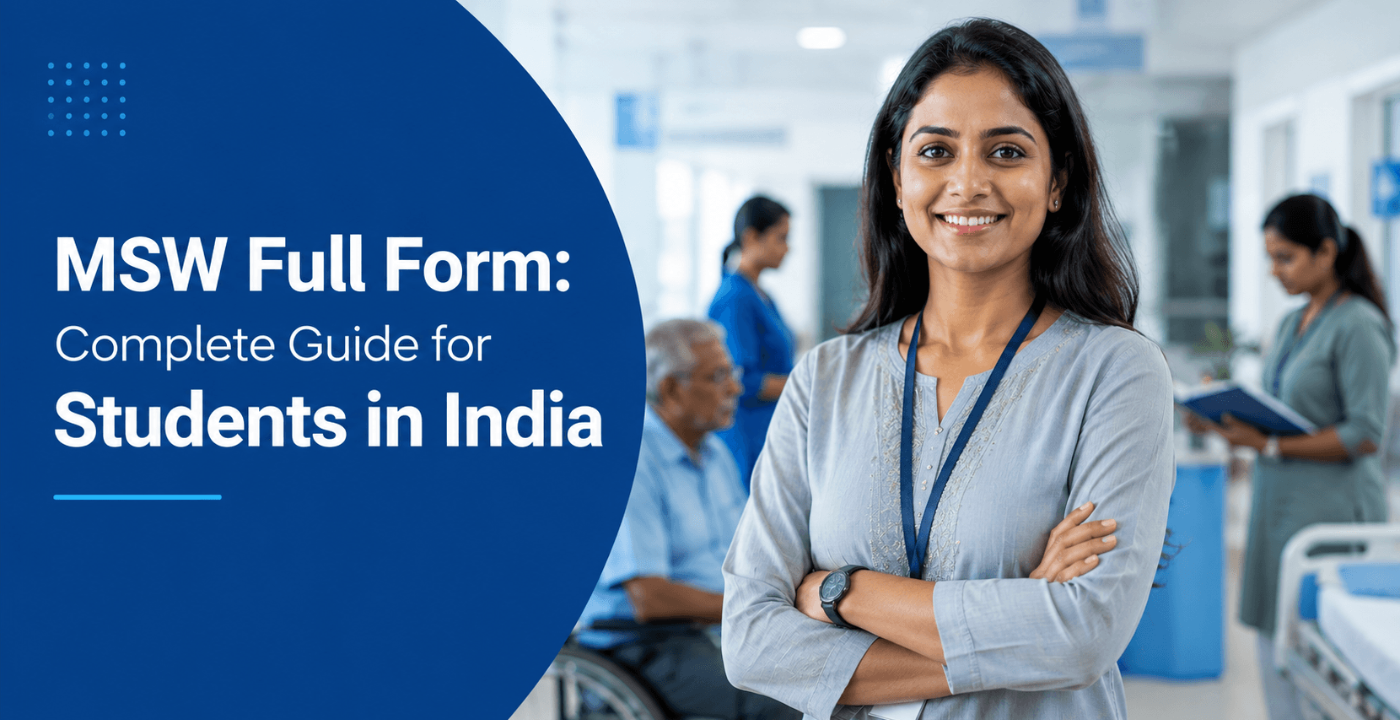
So you keep seeing the letters MSW pop up whenever you look at postgraduate courses, and you are wondering what it actually stands for. Let me tell you straight up. The MSW full form is Master of Social Work. It is a two-year postgraduate degree that trains you to work as a professional social worker. Now, before you picture someone in old clothes distributing food in a slum, let me stop you right there. Social work has changed a lot over the years. Today it is a proper career where you work in hospitals, corporate companies, government departments, and international NGOs. You can earn a decent salary and actually build a stable life while helping people.
What exactly do you study in MSW?
MSW is not one of those degrees where you just memorise textbooks and vomit them out in exams. Yes, there is theory, but a huge chunk of your time goes into fieldwork. You actually go out into communities, talk to real people facing real problems, and figure out how to help them. The course runs for two years and is split into four semesters. In the first year you will study things like Introduction to Professional Social Work, Social Case Work, Analysis of Indian Society, Indian Economics, the Indian Constitution, and Research Methods. You also do fieldwork where you visit villages or urban communities and learn how social work happens on the ground.
The second year gets more specialised. You will study Labour Welfare and Legislation, Poverty and Livelihood, Disaster Management, Women and Child Development, and Community Organisation. Most colleges also make you write a dissertation based on research you do in the field. Some institutes let you pick a specialisation from the second year itself. You can choose Clinical Social Work, Medical and Psychiatric Social Work, Human Resource Management, Family and Child Welfare, Urban and Rural Community Development, Criminology and Correctional Administration, or Mental Health. So if you already know which area interests you, you can dive deeper into that.
Who can apply
Here is the best part. Almost anyone with a bachelor’s degree can apply for MSW. You need to have completed your graduation from a recognised university with at least fifty percent marks. Some colleges prefer students who studied sociology, psychology, or social work in their bachelor’s, but many universities accept students from any stream. So even if you did BCom or BSc or BBA, you are still eligible at most places. There is also no age limit. Whether you are twenty two or forty five, you can join this course if you meet the marks criteria. This makes it perfect for people who want to switch careers midlife and do something that actually feels meaningful.
Read Also: BiMS Login: Registration Guide, Services & Security Explained
Getting Admission Here
Different colleges have different rules for admission. Some give you a seat purely based on your graduation marks. If you scored well in your bachelor’s, you just apply, they check your percentage, and you get in. Other colleges and universities conduct entrance exams. Some popular ones you might have to appear for include CUET PG, CPGET, AP PGCET, BVP CET, TISSNET, BHU PET, and DUET. After clearing the written test, some institutes also hold group discussions and personal interviews. So if you are aiming for a top college like TISS, be ready to speak well and show that you genuinely care about social issues.
Types of courses and what they cost
You do not necessarily have to attend college every single day for two years. There are options. The regular full-time program is the most common one. But if you are already working or you live far from good colleges, you can go for part-time or distance learning. IGNOU offers MSW through distance mode and the fees are very pocket-friendly. There are also online MSW courses now if you prefer studying from home.

Speaking of money, the fees vary wildly depending on where you study. Government colleges charge anywhere from seven hundred rupees to around one lakh eighty six thousand rupees for the entire course. Private colleges can go from four thousand rupees all the way up to four lakh eighty thousand rupees. So whether you have a tight budget or can afford a premium institute, there is an option out there for you.
What can you do after MSW?
This is where people usually get surprised. They think MSW graduates only work in small NGOs for peanuts. That is not true anymore. After completing your degree, you can work as a Social Worker helping families deal with crises. You can become a Mental Health Counsellor supporting people with anxiety, depression, or trauma. You can work as a Child Welfare Specialist protecting children who need care. Hospitals hire Medical Social Workers to help patients and their families navigate treatment and finances. NGOs and government departments hire Project Coordinators and Officers to manage social welfare schemes.
If you are interested in addiction recovery, you can work as a Substance Abuse Counsellor. If you like teaching, you can become an Assistant Professor at a college or university. You can also work as a Research Fellow studying social policies and community problems. The sectors that hire MSW graduates include NGOs, government departments, hospitals, schools, corporate CSR teams, and community development organisations. Some big names that recruit MSW graduates are Goonj, CRY, Accenture, Flipkart, Amazon, Just Dial, Tata Motors, Dabur India, Deloitte, and CVS Health. So yes, you can absolutely work for well known companies with this degree.
How much money can you make?
Let us talk numbers because that matters too. As a fresher right out of college, you can expect to earn between two lakh eighty thousand and five lakh rupees per year. It depends on the city and the organisation. With a few years of experience, this goes up significantly. A Project Coordinator can make around six lakh per year. If you move into academics and become a Professor, you can earn twelve lakh or more annually. So while you might not become a crorepati overnight, you can definitely build a comfortable life.
Studying further after MSW

If two years is not enough for you, there are higher study options. You can pursue a Doctor of Social Work or DSW. You can also do a PhD in Social Work or even a PhD in Psychiatric Social Work if that is your area of interest. These degrees open doors to senior research positions, policy making roles in government, and high level teaching jobs at universities.
Final Word
Is MSW the right choice for you?
Look, if you are someone who only cares about making the maximum amount of money in the shortest time, maybe an MBA or a tech degree is better for you. But if you want a career where you actually feel like your work matters, where you go home knowing you helped someone today, then MSW is worth every minute. The MSW full form is Master of Social Work, but what it really means is a chance to build a career around compassion. Check the admission criteria of colleges near you, see if they accept your graduation stream, and take the first step. You will not regret it.
Read More: What Is Crypto Batter? The Truth Behind the Viral Topic
